Installation
Friday, 14 July 2017
Inspiration: Do Ho Suh
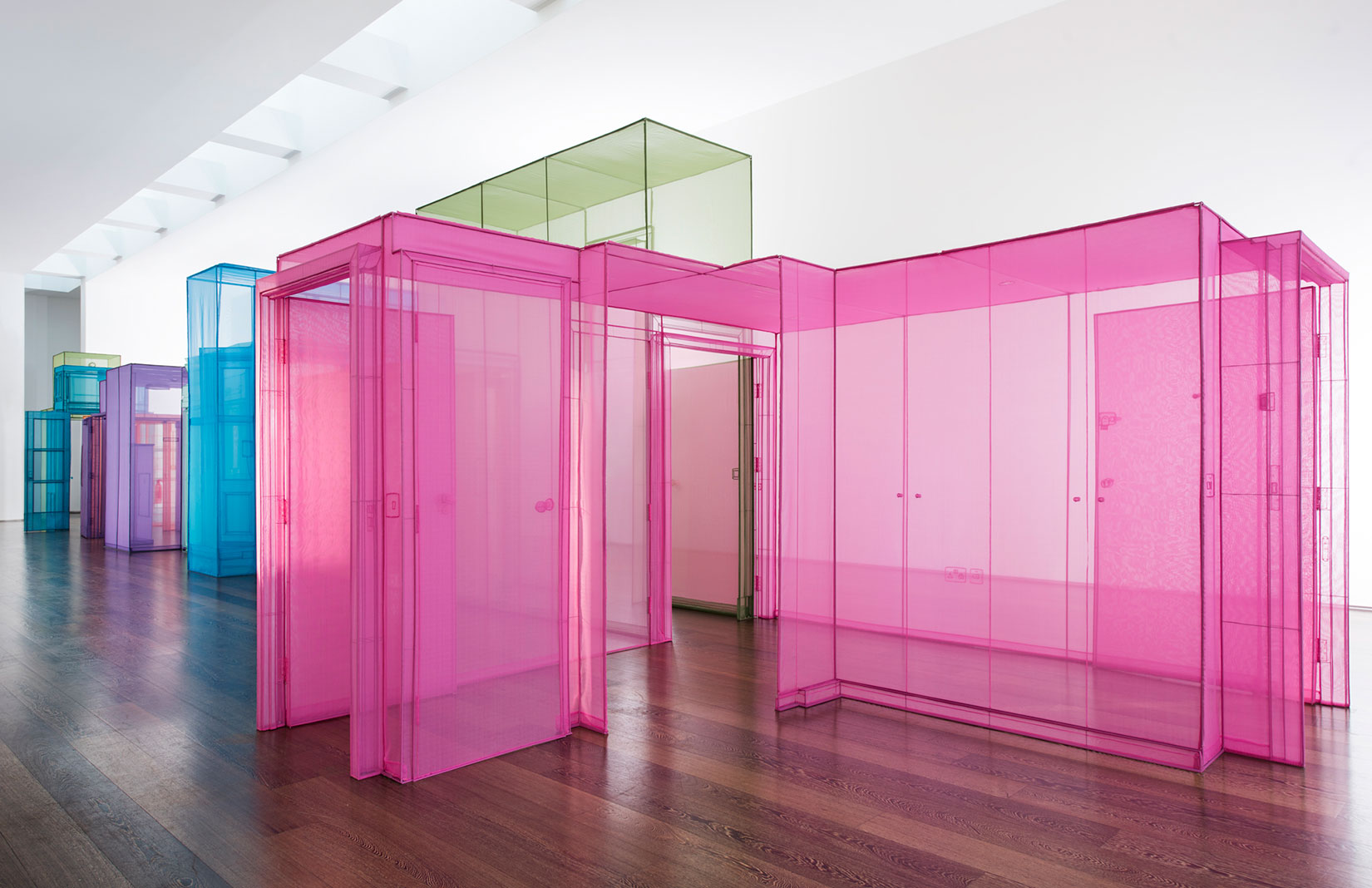
I was fortunate enough to be able to see his solo exhibition at the Victoria Miro and it really blew me away. Some of his ideas and execution of those ideas, the ways in which his pieces could be perceived and understood, as well as techniques he has used resonate with what I am interested in.
It is with the same elegant economy of conceptual means, focusing on simple yet transformative acts of repetition, that Suh treats the complex psychological and physical architectural structures of the concept of 'home'. In work for which he is widely known, the artist meticulously constructs proportionally exact replicas of dwelling places, architectural features, or household appliances – kitchen sinks, toilets and microwaves – from stitched planes of translucent, coloured polyester fabric. Often reflections of places the artist has inhabited, such as his childhood home or Western apartments, these delicately precise, weightless impressions seem to exist between imagination and reality. Suh has spoken of the distinctive openness to the environment of Korean homes; more than repositories of personal memory or nostalgic projections, his works respond to the indistinct boundaries between psychic interior and objective exterior, which make of home an ongoing lived function rather than a physical structure.
His one-to-one scale of physical structures, which was exhibited at the gallery I visited, of passages and corridors of sorts delicately made with translucent fabric gives form to ideas about migration, transience and shifting identities. It was really fascinating to see silhouettes, figurative shapes uniformly meandering through this corridor of colourful polyester fabric when viewing from beyond the installation itself. In this piece though it isn’t his greatest concern, concepts regarding transparency which relates with Lee ByungChul’s theories pervades and exists. It was a totally different way of conveying and playing around with obscuring and revealing things, he made it a multi-sensory experience for the viewer which is something that I aspire to be able to create in the future.
Suh also introduces a new process to produce his large-scale two-dimentional drawings using gelatin tissue sewn in the same way as his architectural fabric pieces. Once immersed in water the gelatin dissolves, leaving behind a trace, a skeletal framework of what the form once was. They are highly visceral works of art, their translucent and ghostly nature making me want to pursue a similar technique when creating surfaces to project onto since there is a distinguishable layered and structured quality to them especially when viewed up close.


Wednesday, 28 June 2017
Inspiration: Pipilotti Rist

Highly accomplished technically and employing dazzling colour, Rist's practice fuses sensual images, music and text to create mesmerising installations. She creates a total sensory experience for her audience by showing her works within architectural installations, conceived specifically for particular spaces. At first glance her work looks incredibly ethereal and captivating, the audience encompassed by colourful, psychedelic imagery such as that in her installation Eyeball Massage. The audience's experiences are akin to those of Lewis Carroll's Alice in Wonderland due to the fact that Rist is constantly attentive to scale and of creating situations in which the viewer feels as though they have shrunk or grown. Her filming techniques reinforces a hallucinatory quality: looping and churning with relentless, uncontrollable movement. Large, voile-like panels appear throughout her Eyeball Massage installation, serving as a projection screen or to veil the imagery from the immediate gaze. The result is something very soft on the senses, imagery that envelops the spectator into the displays.


Rist creates films—playful, psychedelic, sensuous, and often provocative—exploring themes and imagery of birth and death; family and love; the body and the natural world. By exploring size and scale, high and low technology, the natural world and the urban environment, Rist invites her audience to question ways of seeing and experiencing art, and to constantly change their perspectives.
Monday, 12 June 2017
The Self Is All That Can Be Known To Exist

Inspired, fascinated, and confused by the philosophical notion of solipsism, I wanted to investigate the dissonance of our experience of reality when you come to believe that the self is all you can really be sure of that exists. Starting by creating drawings and collages that separate and isolate people from their surroundings - heads from their bodies, limbs from the figures of commuters on a train - removing them from their original context and replacing them into a space, I developed this project into an installation composed of mostly steel wire embellished with threading wire manipulated into shapes and forms from my initial drawings suggestive of human characteristics. These wire forms, two-dimensional and unassuming were then projected onto the surrounding walls to form shadows that overlapped and created line drawings.


I have never wanted to become an installation artist more than after I encountered Yasuaki Onishi’s work. His constructions are so achingly simple yet absolutely breathtaking and consume and engulf spaces and viewers that enter into his spaces. I am intrigued by his use of light and minimalistic approach to his choice of materials because the source of lighting seems to be quite pivotal in the way his sculptures are perceived and how it affects the space they occupy; the materials he uses very accessible and not unnecessarily combined with or embellished with fancy machinery or other mediums.
The way that he grapples with and explores positive and negative spaces, spaces that do and do not exist until he conjures them and makes them artistically relevant like in “Reverse of Volume” where the plastic sheet suspended from the ceiling is molded to impressions of cardboard boxes that were once beneath it, consequently creating this negative space underneath what could be an impressive mountainous landscape. Or the way in which he conjures up spaces within spaces through shadow casts on walls, allowing the viewer the freedom to roam around and bask in this ethereal and unreal setting, perceiving the ‘space that doesn’t exist’ and experiencing it as they see fit. Visitors walk in and out of his contemplative spaces, observing how the simplest qualities of light, shape and line change. I am absolutely inspired by the simplicity of his aesthetics due to the distinct lack of colour and how his installations such as “Vertical Volume” evoke a sense of peace and calm within the viewer because of the expansive stretch of translucent white material.


Subscribe to:
Posts (Atom)
