Alberto Giacometti and Gerhard Richter’s interpretations of pictorial and abstract space.
What is space? “Space”, always decorated with a range of adjectives, has been a major concern in art as well as other disciplines, especially when considering the number of ways ‘space’ can be defined. For example, mathematical space may be conceived as a set of elements or points satisfying specified geometric postulates. In cosmology and astrology, space is the incredibly vast 3-dimensional region that starts where the earth’s atmosphere ends.
However, in terms of art and visual creation “to space” as a verb suggests a process of shaping, arranging and developing. As an element of art, space is the areas around, between or within components of a piece. Space can be positive or negative, deep and shallow, two-dimensional and three-dimensional; sometimes it is more the absence of space and rather an illusion of it. In two-dimensional work, space can be implied in a number of ways: through the use of colours as cool colours tend to recede whilst warm tones advance towards the viewer; linear, isometric and atmospheric perspective show objects in relation to their surroundings; artists may also purposely manipulate our sense of space to create a sense of unreality adding to the narrative of the piece or to provoke the viewer to see space differently.
My interest in artists’ portrayal of space, in particular Giacometti’s and Richter’s was when I came across an investigation on the concept of space in art with a quote by Frank Stella –
"But, after all, the aim of art is to create space - space that is not compromised by decoration or illustration, space within which the subjects of painting can live." [1] (Stella, 1986)
I became intrigued with their influences, approach and response to their medium and consequently the space that developed from their dissimilar ways of painting. Are they formally presenting us with a depiction of the immediate space that the artist or their subject occupy or is the artist simply creating an illusion of space, relying on the process of applying paint and everything else in between to allow us to put their work into context with our own interpretation?
--
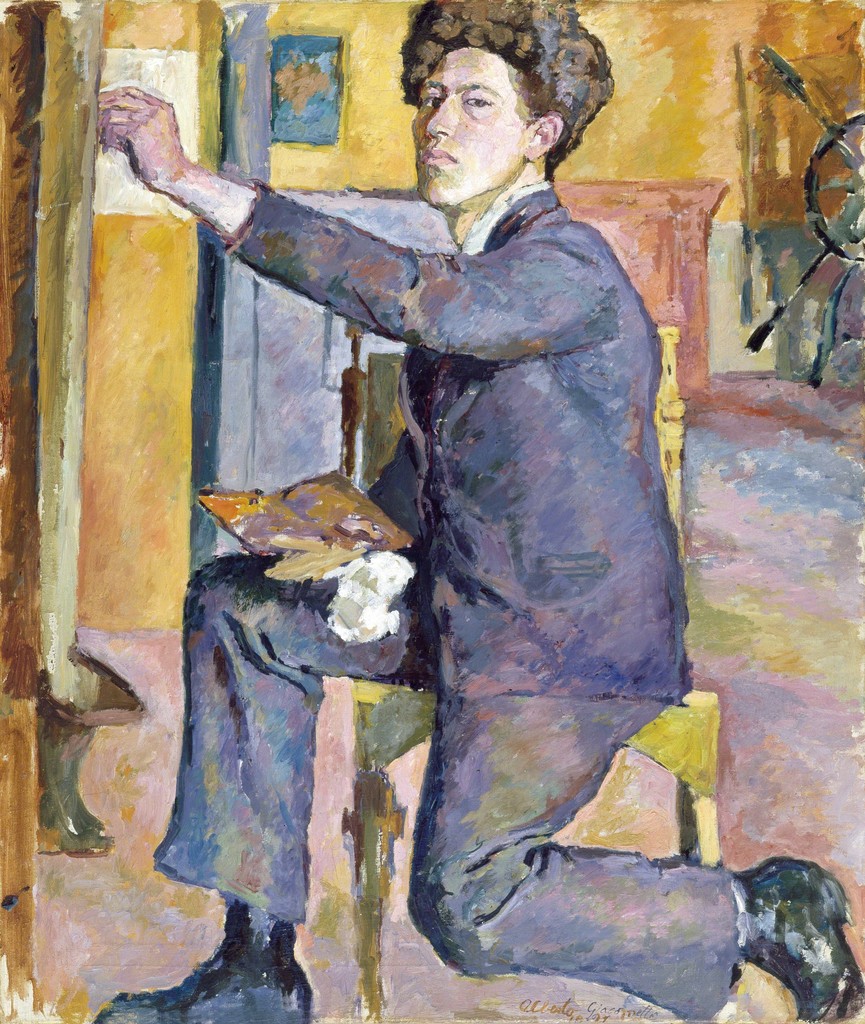 |
| Self Portrait, 1921 |
Born in 1901 and the son of a post-Impressionist painter Giovanni Giacometti, Alberto Giacometti grew up in Switzerland a few kilometres away from the Swiss-Italian border. Already he had the humble beginnings of a blossoming artist with his father and the French Post-Impressionists influencing Giacometti’s artistic development.[2] He began drawing at around 1910-12 and at the age of twelve began modelling heads, mostly of his brother Diego who eventually became one of Alberto Giacometti’s most frequent model. He developed his drawing style primarily through portraiture: a portrait of his mother made in 1918 showing his exceptional way of handling form and stylistic technique. In painting he imitated his father’s fauvist style, exhibiting what he had learnt from his father’s painterly culture in a self-portrait in 1921, also showing an artistic sophistication that would characterize his later works.
At the age of twenty, Giacometti went to Paris to study under the sculptor Antoine Bourdelle at the Académie de la Grande-Chaumière. It wasn’t until 1925 that his artistic intentions were revealed; his dissatisfaction with and not knowing how to advance in representational sculpting subsequently lead him to experiment with the geometric stylization of Cubism and Afro-Oceanic art. ‘Torse’, 1925, a figure condensed to three geometrically stylized blocks channeling a feeling of tribal art was a major turning point in the artist’s career. Giacometti describes his change of approach to sculpting as a product of his desperation, relying on working from memory to create objects that were “as close as he could get to his vision of reality".[3] (Giacometti, 1925)
 |
| Torse (Torso), 1925 |
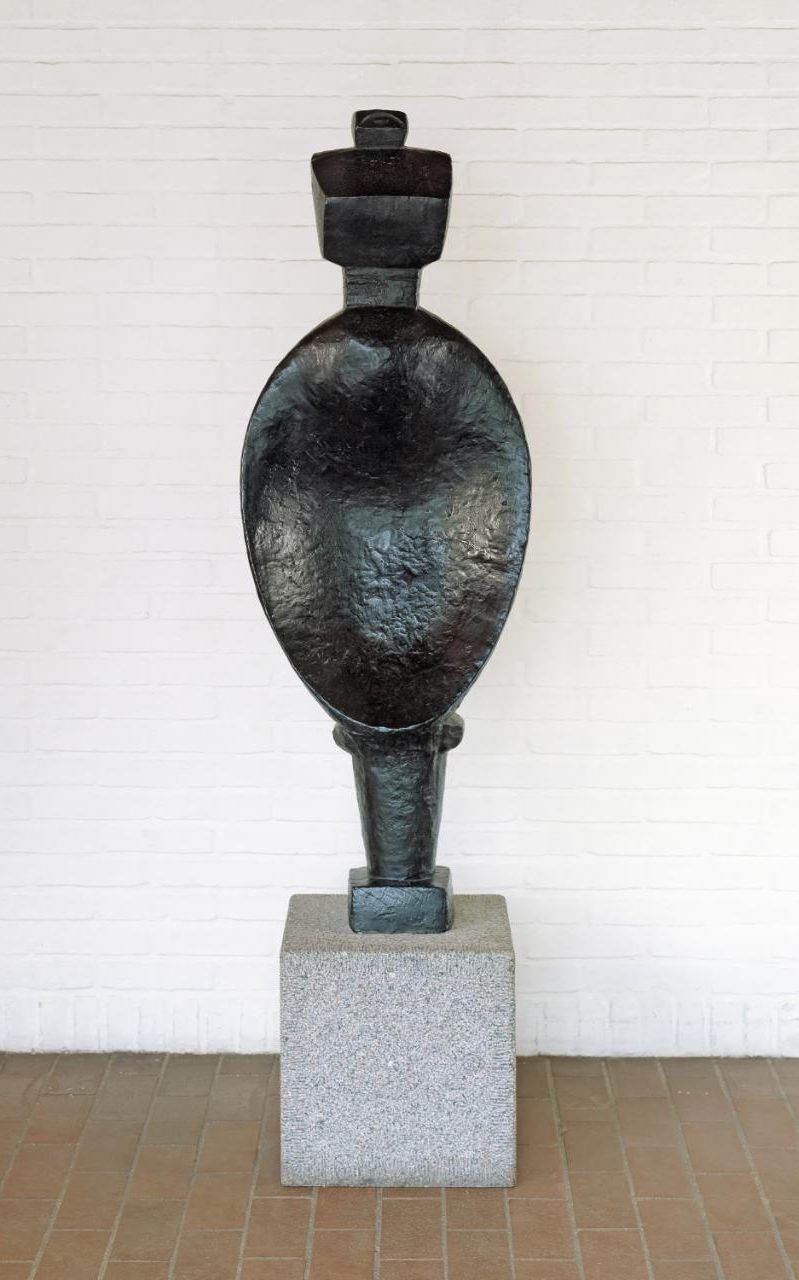 |
| Spoon Woman, 1926-27 |
Soon after sculpting ‘Torse’ he focused his attention on Cubism, creating a series of small sculptures between 1926 and 1927, whilst simultaneously looking to African art for inspiration which resulted in totemic, dramatically simplified figurations.[4] These influences provided him with a whole new perspective on the portrayal of the human figure, allowing him to treat them as independent objects with no immediate resemblance to a model. It is his early experimentations with cubist sculptures that forms the basis for his figurations seemingly suspended in space and time and later his paintings that demonstrate his unique attitude towards relating the figure within a space.
 |
| Walking Man I, 1960 |
--
Gerhard Richter, considered one of the most renowned artists in the world with his exciting compositions wildly varying in genre, had a radically different childhood to Giacometti who was born only 30 years before. Born in 1932 just years before the Second World War, his childhood involved an inevitable encounter with Nazism and a struggle to cope with the pressures of National Socialism. Although his passion for art developed at around the age of fifteen, Richter attempted an array of professions such as forestry, dentistry and lithography, working in a theatre to try to put his artistic skills to commercial use before eventually applying to study painting at the Dresden Art Academy. He returned to his birth city of Dresden in the summer of 1951, committed to starting his formal studies as a painter.[8]
His future works, particularly in the 60’s demonstrated his want for the public to acknowledge the issues in the media and reality that he had experienced and thus preoccupied him in his practice. Due to the rise of the German Democratic Republic in 1949, artists of the state were obligated to support the notion of socialist Germany, using art as a medium to educate citizens on socialist realism. Richter, unhappy with Dresden academy’s obedience to the government’s ideology, began to explore and became immersed in the stylistic and intellectual experiments of modern art.[9] His visit to the Documenta II exhibition in Kassel in summer 1959 where he was exposed to the art of the West after the war – largely dominated by abstract art – was what prompted him to move to West Germany in 1961. Having been used to social realism being the only form of modernity, an encounter with the works of the likes Jackson Pollock and Lucio Fontana triggered a change in his way of thinking and consequently, approach to art.[10]
1966 was the year that the artist began working with a range of grey monochromes, the collection referred to as the ‘Grey Paintings’. This era was also the start of his abstract explorations which he fully engaged in, in the 1970’s and onwards. His early abstract paintings reflected the dissatisfaction he felt in his private life: from his strained relationship with his wife Ema and the premature death of his friend Blinky Palermo, the monochrome paintings seemed bleak in contrast with the colourful and technically and aesthetically exciting abstract works he simply called Abstraktes Bild in the years to follow. [11]
 |
| Weinernte (Vintage), 1968 |
--
Giacometti, though most notably known for his elongated, fragile and vulnerable looking sculptural figures, also painted portraits; the figure and space rough constructions of the artist’s ever-prominent lines and overworked surfaces, a painting style so sharp and distinct and undoubtedly Giacometti’s.
His post-war paintings in particular demonstrate incredible consideration not only for the model he is painting but the space in which the figure is represented. In many of his compositions such as ‘Seated Man’ 1949, ‘The Artist’s Mother’ 1950 and ‘Annette With Chariot’ 1950, the figure appears unmoving, suspended in the surrounding space. Giacometti paints his subjects in a way that the viewer would be able to share the artist’s own sense of distance from his model. I was fortunate enough to be able to see the ‘Seated Man’ in the Tate Gallery and although the scale of the painting was by no means incredibly large, standing a couple of metres away from where I imagined Giacometti would have been when he painted this, there was no mistaking the palpable sense of pictorial space. Here the figure’s head looks too small for the body, the legs almost too long in comparison to the torso, but that only contributes to the sense of perspective and convincing illusion of real space that Giacometti intently captured in his work.
 |
| The Artist's Mother, 1950 |
 |
| Annette with Chariot, 1950 |
 |
| Seated Man, 1949 |
Giacometti constantly reworked his portraits - especially the faces – giving the two-dimensional figures a stern and unwavering expression which often keeps the viewer only looking from a distance. In both his drawings and paintings, the facial features are obscured; sometimes merged together and sometimes simplified, by a vortex of constructional lines illustrating Giacometti’s iconic approach to the head. His obsession with capturing his elusive vision of the sitter on the canvas or on paper led to many overlapping layers of paint or charcoal: rapidly applied lines repeatedly marking what he deems the most important aspects on his subject. Large, heavy circles encompass the eyes of the subject emphasising their gaze. It seems he was concerned not so much with capturing the true character of his models, rather, by fully concentrating on the eye contact between the model and the artist and the viewer, he gives his subjects an existential presence which in my opinion far outshines that of conventional portraiture.
On the other hand, rather than creating a sense of real space from observation of his immediate surroundings, Gerhard Richter’s abstract work is notable for the illusion of space that develops from his incidental process of applying paint. He is known for his extensive use of the squeegee to create his abstractions, producing surfaces that are rich with layers and overlaps of oil paint – some areas scraped and scratched away to reveal and expose previous layers. This accumulation of spontaneous, reactive gestures of adding and taking away paint, unnatural palettes and obvious marks created by the artist’s chosen tools often leads to very obscure depictions of landscapes and warped space.
In his series of paintings titled ‘Wald (Forest)’ 2005, the rhythm created by the vertical lines against the wash of subtle horizontal streaks is reminiscent of a very dense forest. In comparison to Giacometti who closely captured the space he felt and experienced between him and his subjects, Richter doesn’t strive to duplicate nature - or anything in fact - as it appears, rather he invites the viewer to consider the juxtaposition of the colours and the bold textures and to interpret them based on our own perceptions that change according to the work’s context. He himself insists that “pictures which are interpretable and which have meaning are bad pictures.”[12] Despite this, I like to view the majority of his abstractions as perhaps windows to an alternate universe; snapshots of an ever changing landscape, blurred and distorted like the scenes that come and go outside of a moving train. One can experience a whole new world through the ‘space’ that naturally manifests in Richter’s paintings whereas in Giacometti’s paintings, the viewer can only experience the space that occupied the artist’s field of vision which rarely ever extended further than the boundaries of his studio.
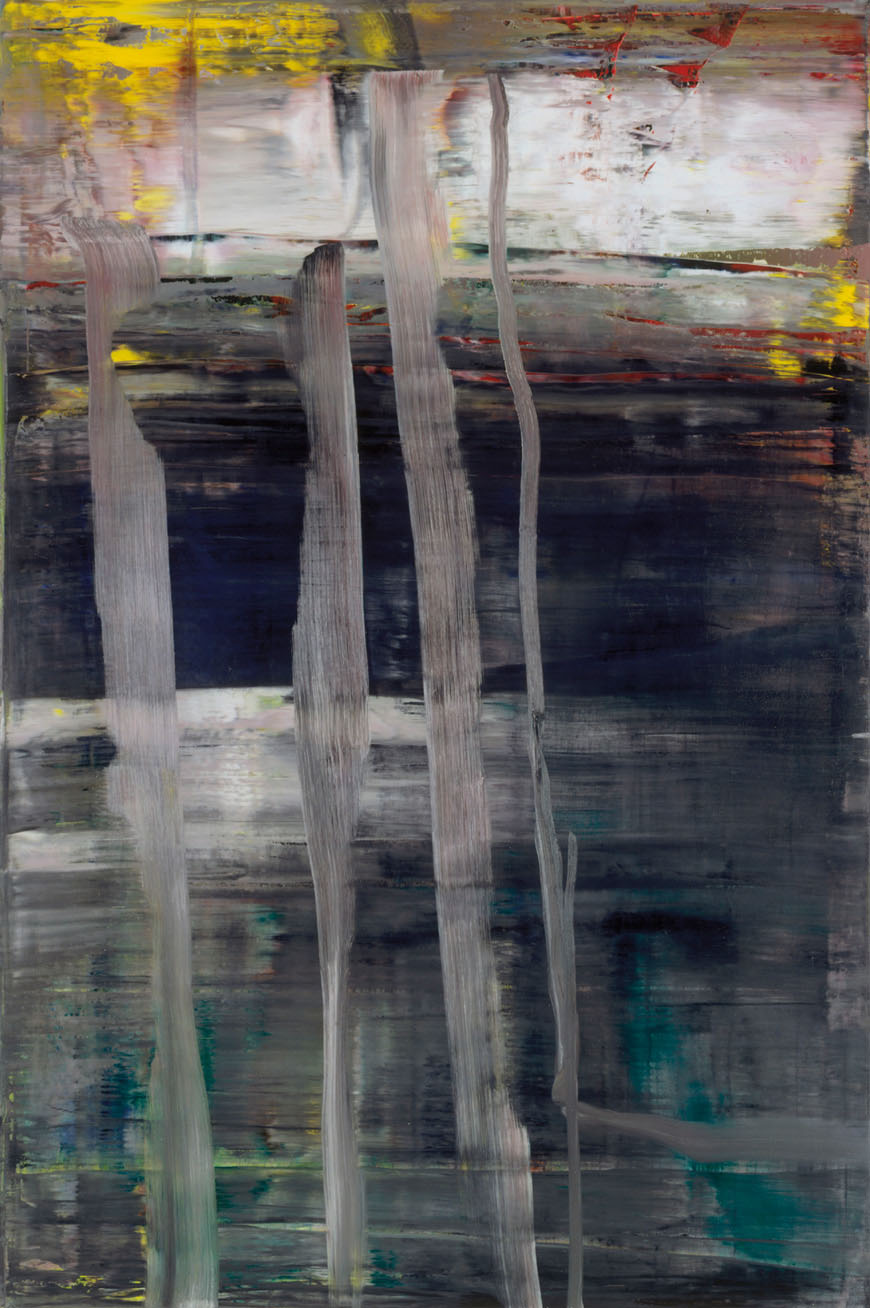 |
| Wald (Forest), 2005 |
Richter ‘blurs’ his paintings, a technique which he perhaps borrowed from photography and corresponds with his desire to avoid projecting any subjectivity in his work. His marks and streaks of paint created with a brush or a squeegee when viewed from afar become perceptible, a space within the chaos of textures; but when viewed up close, the streaks are just what they are - blurred and its overall sense lost amongst the thick paint. I find his abstract compositions incredibly expressive in the sense that his painting process requires a lot of movement especially at the scale that he works at. Though some people may disagree, I think his blurred paintings are incredibly eye-catching and I appreciate the way the individual colours interact and manifest into beautiful gradients, forming this inexplicable illusionary space from the repeated process of applying, smearing, scraping and layering paint. Sometimes his constant reduction of layers results in wave front-like patterns on the surface of his paintings[13]; the placement and quantity of paint affecting the way it spreads creating images that depict cityscapes reflected in water.[14]
When viewed in that context it seems hard to belive that the outcomes of his spontenaiety associated with haphazardness and constant consruction and desctruction are mostly accidental, no matter how calculated his gestures were.
 |
| Abstraktes Bild, 1990 |
 |
| Abstraktes Bild, 1986 |
Both Giacometti’s and Richter’s artistic vision were undeniable shaped by their personal experiences - from encountering death at a young age to their individual perceptual revelations. Both employed opposing approaches to handling paint: one fuelled by his need to capture exactly the energy he felt within the human figure; the other insisting on visual ambiguity and for art to serve as a model for a reality beyond decipherment, to produce captivating pictures representing a subject in relation to their surroundings, and warped abstract space. I have used their techniques in many of my developments and experimentations, drawing inspiration from Giacometti’s line heavy paintings and trialling Richter’s methods of smearing and blurring paint. However I was only focused on the mark making and the aesthetic implications of their techniques and not necessarily the way in which one can achieve pictorial space, or provoke someone into interpreting space that the artist may or may not have intentionally created. This concept of the portrayal or manifestation of space in portraiture and abstract art is something that I would consider exploring further and using in my own future work.
References
[1] Tyler and Ione.
[2] Grenier, Biography of an Oeuvre.
[3] In a letter Giacometti wrote to the art dealer Pierre Matisse along with a catalogue of his works, he omitted anything works completed before the ‘Torse’ and spoke about an aesthetic crisis he experienced in 1925 which lead to the change in approach of sculpting.
[4] ‘Man and Woman’, 1926 (exhibited in the Salon des Tuileries, Paris) and ‘Spoon Woman’, 1926–7 (both Zurich, Ksthaus).
[5] Lord, Giacometti, 258.
[6] Ittner, The Personal Vision of Alberto Giacometti.
[7] Existentialism is a philosophical movement which emphasizes on individual existence, freedom, and choice. It states that man exists and in that existence man defines himself and the world in his own subjectivity, and wanders between choice, freedom, and existential angst.
[8] Hage, Gerhard Richter Biography.
[9] Elger, Richter, 1-11.
[10] Heudron, Richter.
[11] Hage, Gerhard Richter Biography.
[12] Prodger, Blurred Visionary.
[13] Abstraktes Bild, Catalogue Raisonné: 825-11, 1995.
[14] Abstraktes Bild, Catalogue Raisonné: 825-13, 1995.
Bibliography
Elger, Dietmar. Gerhard Richter. A Life in Painting (p1-11); 2009, University of Chicago Press
Heudron, Martine. “Gerhard Richter: Abstract Art that Flirts with Figuration” in News of the Art World 2014
Ittner, Claire. The Personal Vision of Alberto Giacometti, 2012, Davidson College, Davidson, NC
Lord, James. Giacometti: A Biography (p258); 1997, Farrar, Straus, and Giroux
Prodger, Michael. “Blurred Visionary” in StandPoint Magazine October 2011
Tyler, Christopher W. and Ione, Amy. “The Concept of Space in Twentieth Century Art”, 2012
Grenier, Catherine. Biography of an Oeuvre. (http://www.fondation-giacometti.fr/)
Hage, John. Gerhard Richter Biography. (https://www.gerhard-richter.com/en/biography)

Post a Comment